Single-Slide LSR Injection Machine — Start Smart [2026]
2026-05-29 22:07
Most silicone business owners in Southeast Asia start the same way: one or two products, one anchor customer, and a decision about whether to rent molding capacity from a job shop or buy their first machine. The math usually favors owning — within 14-18 months of decent volume, the rental fees exceed the machine purchase price. The problem is that "buying your first machine" in the LSR space quickly turns into a conversation about features you might not need yet, at prices built for factories running 20 machines, not two.
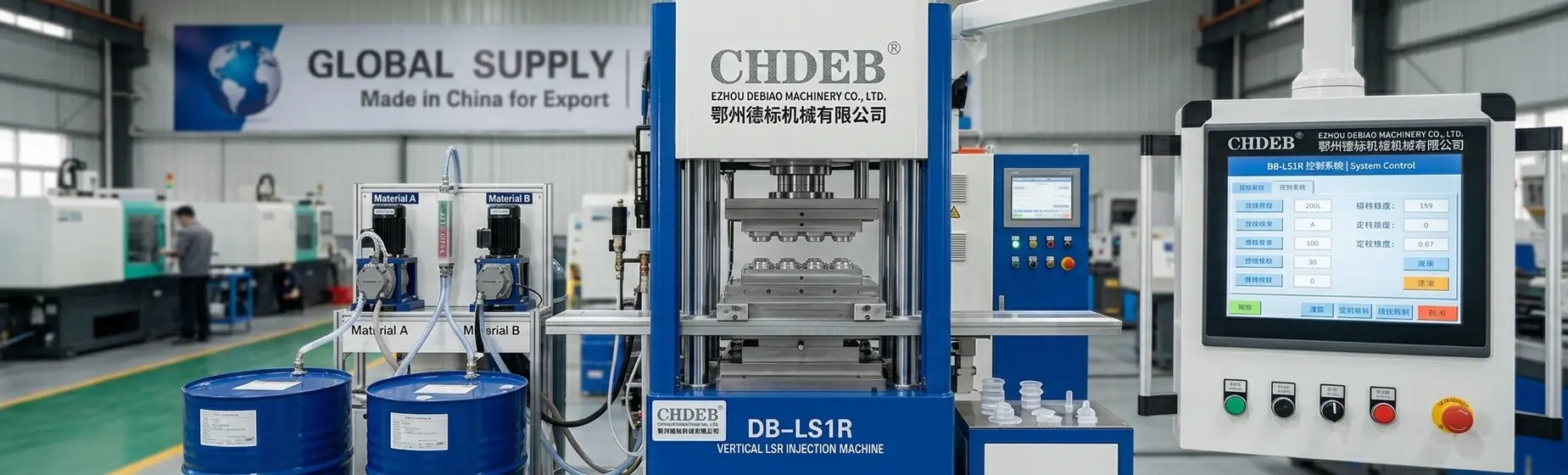
A single-slide LSR injection machine is the correct starting point for most new silicone operations — not as a compromise, but as a deliberate capital allocation decision. The DB-LS1R delivers the same 56 MPa closed-loop injection system and sub-0.1% A/B mixing precision as our double-slide DB-LS2R, at a lower acquisition cost, with a smaller floor footprint, and with the same full-process support that Debiao provides to factories running 30 machines. This guide — from our engineering team at Debiao, a national high-tech enterprise with 50+ core patents manufacturing LSR equipment since 2013 at our 30-acre facility in Ezhou, Hubei — explains how to evaluate whether the DB-LS1R is the right entry point for your operation, and what you should insist on regardless of budget.
Contents [ hide ]
The Startup Silicone Factory Machine Decision — What Nobody Tells You
DB-LS1R Key Specifications: What Matters for Precision Overmolding
Single-Slide vs. Double-Slide: The Decision Framework for a New Operation
Ownership Economics: What the DB-LS1R Costs and When It Pays Back
Full-Process Support: What Debiao Provides Beyond the Machine
The Startup Silicone Factory Machine Decision — What Nobody Tells You
Here's the conversation I have with first-time buyers about twice a month. They've done research, they've seen double-slide machines presented as the professional choice, and they're worried that buying a single-slide machine signals that they're not serious. That concern is backwards. Buying a double-slide machine when your production volume doesn't justify it isn't ambition — it's capital misallocation.
A double-slide machine costs 15-25% more than an equivalent single-slide platform. It requires two lower mold halves per product, adding $3,000-$15,000 in tooling cost depending on part complexity. It occupies 20-30% more floor space. And its productivity advantage — the ability to load one slide while the other is molding — only materializes when your insert loading time exceeds your cure time. For a new factory running two or three product lines at moderate volume, that condition often doesn't exist yet.
I've watched operators at new Thai and Indonesian factories spend the first three months troubleshooting process parameters, validating mold designs, and building customer confidence. During that period, cycle time optimization isn't the constraint — process stability is. A single-slide machine in that context is the right tool. You're not leaving productivity on the table. You're not yet at the volume where that table exists.
⚙️ INSIDER NOTE
The most common mistake first-time LSR machine buyers make isn't underspending — it's overspending on automation features they can't yet fully utilize, while underspending on injection system quality. A cheap machine with poor closed-loop control produces inconsistent parts that lose customers. A well-specified single-slide machine producing consistent, flash-free parts at moderate volume builds the customer relationships that justify a second machine 18 months later. Prioritize the injection system. Everything else is secondary.
What a Single-Slide LSR Machine Actually Is — and Isn't
A single-slide LSR injection machine is a vertical press with one sliding table that moves in and out of the clamping area on a linear track. The injection unit is fixed above; the lower mold half sits on the sliding table; the upper mold half is fixed to the press frame. One table, one mold position, one operation at a time.
That's the complete architecture. No second table, no alternating cycle, no concurrent loading-while-molding workflow. Sequential by design.
How Does the Single-Slide Cycle Work in Practice?
The operating sequence on a DB-LS1R is straightforward:
Mold opens — upper half lifts, slide table extends outward to operator position
Operator removes finished parts (assisted by air ejection on most configurations)
Operator loads inserts into lower cavity (if insert molding; skip for non-insert parts)
Slide table returns to center position under the press
Mold closes — upper half descends, clamping force applied
LSR injection begins — A/B components mixed and injected at closed-loop controlled pressure
Cure dwell at mold temperature (typically 120-180°C for 20-50 seconds depending on part)
Cycle repeats from step 1
Steps 2-3 are the only "idle" period for the injection unit — and for non-insert parts, step 3 doesn't exist. Pure silicone parts with air ejection can cycle in 35-55 seconds total including operator touch time. Insert molding with manual loading adds 8-45 seconds depending on insert count and complexity.
For a new factory owner, this sequential workflow has an underappreciated advantage: it's simple to train on, simple to troubleshoot, and simple to document for customer quality audits. One table. One process window. One set of parameters to optimize.
What Precision Do You Give Up vs. Double-Slide?
Nothing. That's the important answer.
The DB-LS1R and DB-LS2R share an identical injection platform. Same dual A/B injection system. Same 56 MPa maximum injection pressure. Same closed-loop pressure control. Same real-time A/B volume monitoring. Same sub-0.1% mixing ratio deviation.
The double-slide adds a second table and the mechanical architecture to alternate between them. It adds nothing to the injection system's precision. A catheter hub overmolded on a DB-LS1R is dimensionally identical to the same part produced on a DB-LS2R — the only difference is how many you can produce per hour.
Precision is not a function of single-slide versus double-slide. It's a function of the injection system. Buy accordingly.
DB-LS1R Key Specifications: What Matters for Precision Overmolding
Most LSR machine spec sheets bury the numbers that actually determine part quality under pages of general descriptions. Here's what matters for precision overmolding — and what the DB-LS1R delivers on each:
| Specification | DB-LS1R Performance | Why It Matters for Your Parts |
|---|---|---|
| Max injection pressure | 56 MPa (closed-loop) | Forces LSR into micro-features of substrates; ensures complete fill in thin-wall sections ≥0.3 mm |
| Injection pressure deviation | <0.1% (real-time closed-loop) | Eliminates end-of-fill overshoot that causes flash; batch-to-batch consistency for customer QC |
| A/B mixing ratio accuracy | <0.1% deviation from 1:1 | Stable crosslink density → consistent Shore A hardness → passes incoming QC at your customers |
| A/B injection system | Dual system, equal-volume alternate injection | Continuous fresh LSR supply; no stagnation in runner or degraded material reaching cavity |
| Hydraulic system | Dual-proportion design | Flexible independent adjustment of pressure and flow; adapts to different mold geometries without hardware changes |
| Clamping orientation | Vertical — gravity-aligned | Insert rests in cavity under own weight; uniform clamping force across mold face; lower flash risk |
| Monitoring | Real-time A/B pump volume, mixing status, pressure | Instant alarm on parameter drift; process data available for customer quality documentation |
| Slide configuration | Single sliding table | Simpler commissioning, lower tooling cost (1 lower mold vs 2), easier operator training |
| Standard lead time | 15-25 days (standard config) | Faster ramp-up than European LSR machine suppliers at 14-22 weeks lead time |
| MOQ | 1 unit | No forced volume commitment for first purchase; 5% discount on first orders under 3 units |
The specification that new buyers most consistently underweight is A/B mixing deviation. It sounds abstract — "0.1% versus 2%" doesn't feel significant until you understand what it means at the part level. A 2% mixing deviation on a Shore A 45 medical-grade LSR formulation produces parts that range from Shore A 42 to Shore A 48 across a shift. Your customer runs incoming hardness QC. They reject the batch. You absorb the cost and the relationship damage. That's a $0.00 specification difference on the machine purchase — and a very expensive operational difference.
🟢 PRACTICAL TAKE
When comparing DB-LS1R against any competitor machine, ask for one specific number: the A/B mixing ratio deviation across 200 consecutive cycles at rated flow conditions. Not the setpoint accuracy — the actual deviation over time. If the vendor can't produce that data, the machine doesn't have closed-loop feedback. It has open-loop metering with a precision label. Those are not the same thing, and the difference shows up in your scrap rate within the first month.
Single-Slide vs. Double-Slide: The Decision Framework for a New Operation
The right machine depends on two numbers: your insert loading time and your monthly part volume. Everything else is secondary.
If your insert loading time is under 15 seconds — simple single-pin drop-in inserts, non-insert pure silicone parts, parts with air-ejection-only demold — the double-slide's productivity advantage shrinks to 10-20%. The price premium and extra tooling cost aren't justified. Start with single-slide.
If your monthly volume is under 30,000 parts per product line — which describes most new silicone factories in their first 12-18 months — the idle time cost of a single-slide machine is manageable. Even at 25-second loading times and 40-second cure cycles, you're looking at roughly 65-second cycles versus an estimated 42-second double-slide cycle. At 30,000 parts/month, that gap represents about $1,800/month in potential additional output. The double-slide premium is roughly $4,000-$7,000. Payback: 2-4 months at that volume — but only if you have the orders to fill the additional capacity.
If you're still validating your product and customer base — single-slide, unconditionally. You need process stability and learning time, not maximum throughput.
A silicone factory owner in Surabaya I spoke with in mid-2025 put it simply: "I bought a single-slide first because I needed to prove the product before I could justify the investment in a second mold set. By month ten I had the orders to justify the double-slide, and because both machines use the same system, my operators already knew everything about it." That's the intended upgrade path — and it's why both machines share the same injection platform.
Ownership Economics: What the DB-LS1R Costs and When It Pays Back
Own vs. Rent: When Does Machine Ownership Beat Job Shop Pricing?
Job shop pricing for LSR molding in Southeast Asia (Thailand, Vietnam, Indonesia, Malaysia) typically runs $0.08-$0.25 per shot including material, depending on part complexity, cavity count, and relationship with the subcontractor. That sounds low until you run the monthly numbers at scale.
Take a common scenario: 8-cavity mold, 30,000 finished parts per month, $0.12 per shot from a job shop. That's $450/month in processing fees — on top of your material cost, which you're also paying the job shop to source at their markup. At $0.12/shot with a typical 8-12% material markup, you're paying roughly $540/month total.
On your own DB-LS1R:
Machine amortization: 5-year straight-line → approximately $320-$420/month depending on purchase price configuration
Electricity: ~$45-$65/month at Southeast Asian industrial rates for the machine's power draw during production
Operator labor: 1 operator at local rates — already in your headcount for inspection and packaging anyway
Material: Direct purchase from Dow, Wacker, or Shin-Etsu distributor at 8-12% below job shop sourcing cost
Break-even against job shop pricing typically occurs between month 10 and month 18 for a 30,000-parts/month program — sooner if you're running multiple product lines on the same machine, sooner still if your job shop charges rush fees for urgent orders (which they always do eventually).
The less quantified advantage: once you own the machine, you control your lead time. No waiting for a job shop slot. No being deprioritized when the job shop lands a bigger customer. For a new business building customer relationships, delivery reliability is worth more than the break-even calculation suggests.
What Is the Upgrade Path When Volume Grows?
The DB-LS1R is not a dead end. It's the first node in a defined upgrade path.
When your volume justifies it — typically when loading time exceeds cure time on your anchor product, and monthly volume passes 40,000-50,000 parts on that line — adding a DB-LS2R alongside the DB-LS1R gives you a mixed fleet that covers both scenarios. High-insert-complexity products run on the DB-LS2R for throughput. New product trials and lower-volume specialty runs stay on the DB-LS1R where the simpler workflow is actually an advantage for process development.
Because both machines share the same injection platform, mold design, process parameters, and operator training all transfer directly. A mold validated on the DB-LS1R runs on the DB-LS2R without revalidation — assuming the same injection pressure profile and cure parameters. That compatibility isn't accidental. We designed it that way specifically for factories that start small and scale.
According to MarketsandMarkets (2026), the Asia-Pacific LSR equipment market is projected to grow at 7.8% CAGR through 2029, with the strongest growth segment being small-to-mid-volume contract manufacturers in ASEAN markets. The entry-point machine decision made by factory owners in that segment today determines whether they're scaling a coherent production system or replacing incompatible equipment in three years.
Full-Process Support: What Debiao Provides Beyond the Machine
For a startup silicone factory owner in Southeast Asia, the machine is the beginning of the relationship — not the end of it. The support structure around it determines whether you get productive in two months or six.
Here's what Debiao provides with every DB-LS1R purchase, regardless of whether you buy one machine or ten:
Pre-shipment documentation package: Complete machine specifications, electrical schematics, hydraulic diagrams, parameter setup guide, and a video commissioning library in English. The videos walk through initial power-on, hydraulic fill, injection system priming, first-shot parameter setup, and alarm response procedures. Your operator can watch these before the machine arrives.
Remote commissioning support: Our engineering team schedules a video call on the day your machine arrives for initial setup. We walk through hydraulic system verification, injection unit calibration, and first-shot parameters together — in real time, in English. We don't leave you with a manual and a phone number that goes to a call center.
Process setup consultation: Send us your part drawing and your LSR grade datasheet before you start. We'll provide a starting parameter set — injection pressure, cure temperature, cure time, A/B flow rate — based on our production experience with similar geometries. You'll still need to fine-tune on your specific mold, but you start from a calibrated baseline rather than from zero.
Spare parts availability: All consumable components — hydraulic seals, injection barrel components, proximity sensors, proportional valve cartridges — are stocked at our Ezhou facility and ship via DHL Express. Typical delivery to Bangkok: 3-4 days. To Jakarta: 4-5 days. To Ho Chi Minh City: 3-4 days.
Lifelong technical support: Not a 12-month warranty that expires. When you have a process question two years after purchase — and you will, because LSR processing has a real learning curve — our engineering team takes the call. That commitment is in our standard commercial terms, not a premium add-on.
💡 PRO TIP
Before your machine arrives, prepare three things: a dedicated electrical supply line at your machine's specified amperage (don't share with other equipment — voltage fluctuations from other machines affect injection pressure stability), a clean water cooling line for the mold temperature controller, and a designated space with 20cm clearance on all sides for the slide table to extend. Having these ready means your commissioning video call is spent on process setup, not on infrastructure problems. The factories that get productive fastest are the ones that prepare before the machine arrives, not after.
The startup discount is real and automatically applied: 5% off your first order under 3 units. On a DB-LS1R, that's a meaningful reduction. No code required, no negotiation — it's built into the proforma invoice for first-time buyers.
Frequently Asked Questions
What is a single-slide LSR injection machine?
A single-slide LSR injection machine is a vertical liquid silicone rubber press with one sliding table that moves in and out of the clamping zone for part removal and insert loading. The injection unit and upper mold are fixed; the lower mold travels on the slide. The workflow is sequential — one operation at a time — making it simpler to commission, operate, and troubleshoot than double-slide configurations.
Is the DB-LS1R suitable for precision overmolding, or is it only for simple parts?
The DB-LS1R handles precision overmolding fully — including medical-grade insert overmolding requiring flash-free surfaces. It delivers the same 56 MPa closed-loop injection system and sub-0.1% A/B mixing deviation as the double-slide DB-LS2R. The single-slide configuration affects throughput, not injection precision. Parts requiring tight dimensional tolerances (±0.1-0.2 mm) and consistent Shore A hardness are within its capability.
What is the difference between the DB-LS1R and DB-LS2R?
Both machines share an identical injection platform — 56 MPa, closed-loop, sub-0.1% A/B deviation. The DB-LS2R adds a second alternating slide table, allowing concurrent loading and molding operations. This increases output by 30-90% for insert molding applications where loading time is significant. The DB-LS2R costs 15-25% more and requires two lower mold halves per product versus one for the DB-LS1R.
How do I know if single-slide is the right choice for my startup silicone factory?
Single-slide is the right choice if: your insert loading time is under 15 seconds, your monthly volume per product line is under 30,000 parts, you're still in product validation stage, or your budget makes the double-slide premium difficult to justify before customer volume is confirmed. Double-slide becomes worthwhile when your loading time exceeds your cure time consistently across anchor products.
Can I upgrade from DB-LS1R to DB-LS2R later without replacing my molds?
Yes — with one modification. The upper mold half (fixed to the press) transfers directly to a DB-LS2R. The lower mold half sits on the slide table, so you'll need a second lower half for the second slide. The injection parameters, cure profile, and part dimensions validated on the DB-LS1R apply directly to the DB-LS2R without revalidation, because both machines use the same injection platform.
How long does it take to get a DB-LS1R shipped to Thailand, Vietnam, or Indonesia?
Standard DB-LS1R production takes 15-25 days from order confirmation. Ocean freight from Shanghai to Bangkok (Laem Chabang) adds approximately 7-10 days; to Ho Chi Minh City 5-8 days; to Jakarta (Tanjung Priok) 8-12 days. Total door-to-port timeline is typically 22-37 days for standard ASEAN destinations — significantly faster than European LSR machine suppliers running 14-22 week lead times in 2026.
What after-sales support does Debiao provide for a single-machine purchase?
Every DB-LS1R purchase — regardless of quantity — includes: remote commissioning support via video call in English, a complete documentation package (schematics, parameter guide, video library), process parameter consultation for your specific parts, DHL Express spare parts delivery to ASEAN ports in 3-5 days, and lifelong technical support from our engineering team. The support package does not change based on order size.
Where can I buy a DB-LS1R single-slide LSR machine directly from the manufacturer?
Debiao sells factory-direct from our 30-acre manufacturing base in Ezhou, Hubei, China. MOQ is 1 unit. First orders under 3 units receive a 5% discount automatically on the proforma invoice. Contact us at chdeb.com/contact or WhatsApp +86-18321638559. We typically respond with pricing and machine specifications within 24 hours.
The Right First Machine Builds the Right Second Machine Decision
Five things to carry from this:
A single-slide machine is not a budget compromise — it's the correct capital allocation for a new silicone operation where process validation, customer development, and production learning are the real constraints, not throughput.
The DB-LS1R delivers identical injection precision to the DB-LS2R: 56 MPa closed-loop, sub-0.1% A/B deviation, real-time monitoring. The slide count affects output, not part quality.
Break-even against job shop pricing typically occurs in month 10-18 at 30,000 parts/month — sooner on multiple product lines, sooner on products where your job shop charges rush premiums.
The upgrade path from DB-LS1R to a mixed fleet including DB-LS2R is designed in — shared injection platform, transferable molds (upper half), transferable parameters, zero operator retraining.
Full-process support from commissioning through lifelong maintenance comes with every machine, regardless of whether you're buying one unit or twenty.
One more thing worth saying directly: the 5% first-order discount exists because we recognize that the first purchase is the hardest one for any new business. It's not a marketing tactic. It's an acknowledgment that trust runs in both directions — you're taking a risk on us, and we want to make that concrete.
If you want to talk through whether a DB-LS1R fits your specific parts and production volume before committing, that conversation is free. Send us a drawing and tell us what you're trying to make.
References & Sources
Liquid Silicone Rubber Market — APAC Growth Forecast 2026-2029 — MarketsandMarkets (2026)
Liquid Silicone Rubber Market Size, Share & Trends Report — Grand View Research (2025)
ELASTOSIL® LR — Liquid Silicone Rubber for Injection Molding — Wacker Chemie AG (2025)
ISO 294-1: Plastics — Injection Moulding of Test Specimens — International Organization for Standardization
Ready to Start Your Silicone Business with the Right Machine?
DB-LS1R single-slide vertical LSR machine · 56 MPa closed-loop · Sub-0.1% A/B precision · MOQ 1 unit · 5% first-order discount · Full-process support · Factory-direct from Debiao.
Technical Director at Ezhou Debiao Machinery Co., Ltd. — A national high-tech enterprise manufacturing vertical and horizontal LSR injection molding equipment since 2013. 50+ core patents. 30-acre production base in Ezhou, Hubei, China. Supports startup and scale-up silicone factory operations across Southeast Asia, the Middle East, and Latin America with factory-direct machine supply and full-process technical support.
ezdbjx@163.com · WhatsApp: +86-18321638559