

Medical Silicone Overmolding: Achieve Flashless LSR Parts [2026]
2026-05-29 21:43
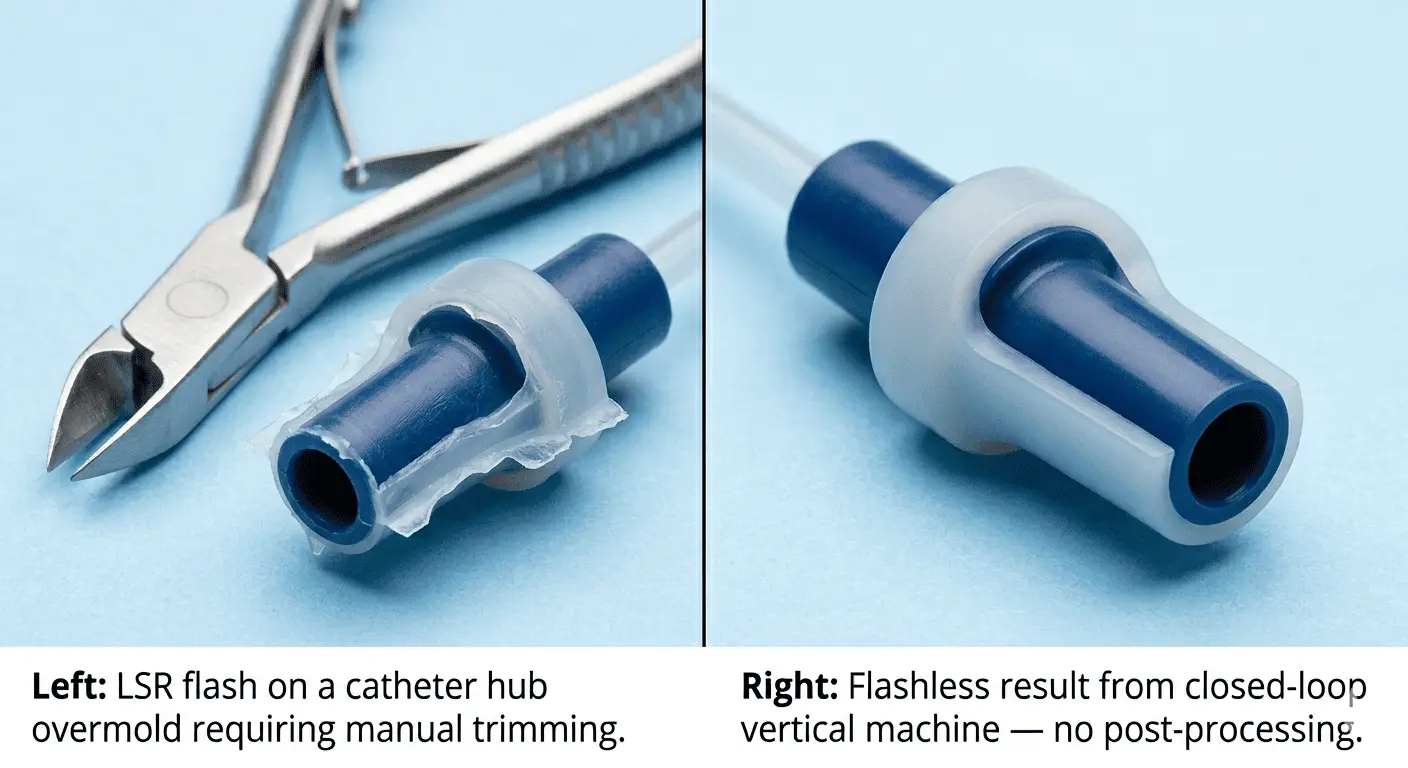
A technical director at a Midwest medical device contract manufacturer told me their trimming line for overmolded silicone catheter hubs employed six full-time operators — working a dedicated station between molding and clean-room packaging — doing nothing but removing flash under magnification, eight hours a day. Fully burdened labor cost: roughly $340,000 per year. For flash. Not for molding, inspection, or assembly. For removing material that shouldn't have been there in the first place.
Flash in medical silicone overmolding isn't a cosmetic nuisance. It's a regulatory risk, a contamination pathway, and a manufacturing cost that compounds with every unit. Under FDA 21 CFR Part 820 (Quality System Regulation) and ISO 13485:2016, flash on LSR medical devices constitutes a dimensional nonconformance requiring documented corrective action — or rework that must itself be validated. This guide, from our engineering team at Debiao (a national high-tech enterprise manufacturing vertical silicone medical machines since 2013, with 50+ core patents at our 30-acre facility in Ezhou, Hubei), explains exactly where flash originates in LSR medical overmolding and how closed-loop machine control eliminates it at the source.
Contents [ hide ]
How Closed-Loop Control Under 0.1% Deviation Eliminates Flash
How Does 56 MPa Closed-Loop Injection Prevent Flash at the Parting Line?
How Vertical Clamping Geometry Reduces Parting Line Separation
Medical Device Applications Where Flashless LSR Overmolding Is Non-Negotiable
Machine Qualification for Medical LSR: IQ, OQ, PQ Considerations
Why Flash Forms in LSR Medical Overmolding — The Physics
Flash in LSR molding is excess material that escapes through the parting line, ejector pin clearances, or substrate interface gaps during injection and cure. Unlike thermoplastic flash — which requires the melt to exceed the gate or parting line gap — LSR flash operates on entirely different physics. And that's what makes it so persistent in medical overmolding applications.
LSR has a viscosity of 20-80 Pa·s at injection conditions — roughly 50-200 times lower than a typical thermoplastic melt. Water has a viscosity of approximately 1 mPa·s; LSR is about 20,000-80,000 times more viscous than water. That sounds substantial until you consider that a typical mold parting line has surface roughness in the 0.4-1.6 μm Ra range and micro-gaps from thermal expansion that open to 5-25 μm during the molding cycle. LSR flows into those gaps. Thermoplastic cannot.
This means that flashless LSR molding requires parting line tolerances, clamping uniformity, and injection pressure control that simply don't apply to thermoplastic processing. A mold that produces zero flash with polycarbonate will produce flash with LSR on the same press — not because the mold is wrong, but because the material is fundamentally more penetrating.
For medical overmolding specifically, the problem is compounded. You're sealing LSR around a rigid plastic or metal substrate — a transition geometry where the parting line must accommodate both the substrate insert and the LSR fill. Any positional variation in the substrate, any inconsistency in how the mold closes around it, and any injection pressure overshoot generates flash at that transition boundary.
The Real Cost of Flash in Medical LSR Production
What Does Manual Trimming Actually Cost Per Part?
Manual flash trimming in a medical environment isn't a factory floor operation — it's a controlled environment operation, typically performed under ISO Class 7 or Class 8 clean-room conditions, by trained operators working under magnification with validated trimming tools. Every element of that process adds cost and adds risk.
Run the math on a typical catheter hub overmold program:
Trimming labor: 4-8 seconds per part under clean-room conditions → at a fully burdened rate of $28/hr → $0.031-$0.062 per part
Rework validation overhead: Trimming is a secondary operation that requires its own process validation under 21 CFR Part 820 / ISO 13485 → one-time cost of $15,000-$40,000 for IQ/OQ/PQ, recurring cost for batch records and QC sampling
Particle contamination risk: Every trimming action generates silicone microparticles. In a catheter or implant-adjacent application, a contamination event triggers a batch rejection — typically $8,000-$45,000 per incident depending on batch size and downstream traceability requirement
Yield loss from trimming damage: Even skilled operators nick the functional silicone surface during trimming at rates of 0.3-1.2% on complex geometries → those parts are scrapped at full production cost
For a program running 500,000 units/year with 6 seconds of trimming per part, the direct labor alone is 833 operator-hours — before clean-room overhead, gowning time, or inspection. At $28/hr, that's $23,333/year in trimming labor for one product line. Scale to four product lines and you have a problem that justifies a capital equipment decision.
What Happens When Flash Triggers an FDA Nonconformance?
LSR medical devices produced under 21 CFR Part 820 require that any deviation from the device master record (DMR) — including dimensional out-of-spec from flash — be documented as a nonconformance and dispositioned through your corrective and preventive action (CAPA) system. Flash that exceeds dimensional tolerances can't be quietly trimmed and shipped. It generates a paper trail.
Under ISO 13485:2016, clause 8.3 (Control of nonconforming product) requires documented evidence that rework processes — including trimming — are validated to the same standard as the original process. A trimming operation that isn't in your DMR as a validated step means every trimmed part is technically produced outside validated process parameters.
That's not a theoretical risk. FDA warning letters have cited LSR device manufacturers for exactly this failure mode — rework performed without validation documentation — as recently as Q4 2025. The remediation cost of a 483 observation related to rework validation typically runs $80,000-$250,000 in quality system remediation and production hold time.
⚙️ INSIDER NOTE
The most defensible position in an FDA audit for an LSR overmolding program is: "Our validated process produces no flash. Trimming is not a defined process step." That statement requires a machine with the process capability to back it up. It's a much stronger QSR position than "our trimming process is validated" — because validated rework still implies a process that routinely produces nonconforming output. Auditors notice the difference.
Four Machine-Side Root Causes of LSR Flash
Mold design gets blamed for flash first. Sometimes that's correct — inadequate parting line fit, insufficient vent design, or wrong gate location all contribute. But in medical overmolding programs where the mold has been correctly validated, flash reappearing in production is almost always a machine stability issue. These are the four I see most frequently:
Injection pressure overshoot at end-of-fill. Open-loop injection systems command a pressure setpoint without feedback on actual cavity pressure. At end-of-fill when the cavity is nearly full, even a brief pressure spike of 3-5 MPa above setpoint forces LSR past the parting line. Closed-loop systems detect the fill completion signal and begin hold-phase pressure reduction in real time — eliminating the overshoot spike entirely.
A/B mixing ratio drift causing viscosity variation. This is the underdiagnosed one. When the A/B ratio drifts toward B-excess (crosslinker surplus), early-stage crosslinking begins in the runner before the cavity is filled. Partially crosslinked LSR has unpredictable viscosity — sometimes lower than expected, sometimes higher — and the injection pressure profile calibrated for fresh 1:1 LSR no longer applies. The machine overshoots to compensate, and flash follows.
Inconsistent clamping force across the mold face. Thermal expansion during a production shift causes platens to grow non-uniformly. On a machine without active clamping compensation, the clamping force at the mold corners can drop 8-15% versus centerline after two hours of running at cure temperature. That local reduction allows parting line separation — and LSR, with its ultra-low viscosity, finds it immediately.
Substrate positioning variation in overmolding. Each cycle, the plastic substrate sits in the lower cavity. Variation of ±0.15 mm or more in substrate position — from operator handling, or from insert fixture wear — changes the parting line gap geometry around the substrate perimeter. That variation directly determines flash generation at the substrate-to-LSR interface, which is the most common flash location in medical overmolding.
Worth stating directly: none of these four root causes is fixable by better trimming. They're fixable by machine parameter control.
How Closed-Loop Control Under 0.1% Deviation Eliminates Flash
How Does 56 MPa Closed-Loop Injection Prevent Flash at the Parting Line?
The relationship between injection pressure and flash in LSR is not linear — it's threshold-based. Below the parting line separation pressure for a given mold clamp load, no flash occurs regardless of how precisely you control injection. Above that threshold, flash appears immediately and increases with pressure. The critical parameter isn't just the peak pressure — it's the consistency of peak pressure across every cycle.
Our DB-LS series vertical machines deliver up to 56 MPa injection pressurethrough a dual A/B system with closed-loop feedback. The system monitors actual injection pressure in real time — not commanded pressure — and adjusts the proportional valve response within the same cycle. Pressure deviation is held below one thousandth of the setpoint across the full fill and hold phase.
What that means practically: if you're running a catheter hub overmold at 38 MPa fill pressure, the system holds 37.96-38.04 MPa across every shot, every shift, every day. On an open-loop machine, that same setpoint produces actual pressures ranging from 36-41 MPa depending on LSR batch viscosity variation, temperature drift, and pump wear. The 41 MPa shots produce flash. The 36 MPa shots produce short fills. Neither is acceptable in a Class II medical device program.
Why A/B Mixing Deviation Above 1% Directly Causes Flash
The connection between A/B ratio and flash is mechanistic, not coincidental.
LSR viscosity at injection conditions is a function of crosslink initiation state — which begins the moment A and B contact in the mixing head. A perfectly mixed 1:1 ratio gives predictable, stable viscosity through the runner and into the cavity. A ratio of 1:1.03 (3% B-excess) initiates crosslinking slightly faster, meaning by the time LSR reaches the parting line at the far end of the cavity, its viscosity has risen above the value the injection pressure was calibrated for. The machine's closed-loop system responds by increasing pressure — and that pressure increase occurs exactly when the cavity is nearly full, which is precisely when parting line flash risk is highest.
Our DB-LS series independently pumps and meters A and B components, detecting feed switch position and monitoring pump volume in real time. Dynamic closed-loop adjustment maintains the 1:1 ratio with deviation below 0.1% — one order of magnitude tighter than the 1% threshold where viscosity-driven pressure compensation begins to generate flash.
I ran a comparison at a customer facility in Ontario in early 2026. Their previous machine — an open-loop competitor unit — showed A/B ratio variation of ±2.8% over an 8-hour shift by pump volume log analysis. Their flash rate on a 6-cavity silicone respiratory mask seal mold was 11.3% of parts requiring trimming. After commissioning a DB-LS1R, ratio variation dropped to ±0.08%. Flash-requiring parts: 0.4% — driven almost entirely by the occasional substrate positioning variation in a manually loaded cavity, not by the injection system.
How Vertical Clamping Geometry Reduces Parting Line Separation
On a vertical LSR machine, the clamping force acts downward — aligned with gravity — onto a horizontally oriented mold. This geometry has two specific advantages for flashless medical overmolding.
First, clamping force distribution across the mold face is more uniform in vertical orientation. Gravity assists in maintaining even contact pressure at the parting line rather than requiring the clamp to counteract gravitational sagging of mold components as in horizontal machines. For large medical molds with multiple cavities — 8 to 16 cavities is common for catheter components — uniform clamping force across the full mold face is directly measurable in flash consistency from cavity to cavity.
Second, and more relevant to overmolding: the substrate sits on the lower mold half under gravity-assisted positioning. It doesn't have to be magnetically retained or clip-held against injection flow forces. That means substrate position is more repeatable cycle to cycle — and repeatability in substrate position is the primary driver of repeatability in the parting line gap geometry that determines flash.
Flashless LSR Molding: Machine Specs That Actually Matter
Not every machine specification on a sales sheet affects flash. Here's what does — and how the DB-LS series compares to typical open-loop vertical LSR machines on the parameters that determine flash outcome in medical production:
| Parameter | Impact on Flash | Open-Loop Machine (Typical) | DB-LS Series (Debiao) |
|---|---|---|---|
| Injection pressure control | Direct — overshoot causes flash | Open-loop; ±4-8% deviation typical | Closed-loop; <0.1% deviation |
| A/B mixing ratio accuracy | Viscosity variation → pressure compensation → flash | ±1-3% ratio variation over shift | <0.1% deviation, real-time monitored |
| Max injection pressure | Must reach 30-56 MPa for medical geometries | Varies; often 20-40 MPa nominal | Up to 56 MPa (closed-loop) |
| Hydraulic system | Pressure stability during fill and hold | Single-proportion; pressure drops under load | Dual-proportion; flexible pressure/flow control |
| Clamping orientation | Parting line separation risk | May be horizontal; uneven force distribution | Vertical; gravity-aligned, uniform clamping |
| Real-time monitoring | Cycle-to-cycle process consistency | Limited or none; manual periodic checks | Real-time A/B volume, pressure, mixing status |
| Process data logging | Essential for 21 CFR Part 820 / ISO 13485 | Often absent or manual | Cycle-by-cycle parameter log available |
The data logging row deserves specific attention. For medical device manufacturers operating under 21 CFR Part 820 and ISO 13485:2016, process data for every production lot is a quality system requirement — not optional. A machine that doesn't log injection pressure, A/B ratio, and cycle parameters electronically forces manual data entry, which introduces transcription error and creates audit vulnerability. The DB-LS series generates cycle-by-cycle parameter records that can be directly exported to your electronic batch record system.
🟢 PRACTICAL TAKE
When evaluating vertical LSR machines for medical production, ask every vendor for two documents: a process capability study (Cpk data for injection pressure across 500+ consecutive cycles at rated conditions) and a sample parameter log export showing what data fields the machine records per cycle. A machine that can't produce a Cpk study for its own injection pressure isn't ready for medical production — regardless of what the brochure says about "precision control."
Medical Device Applications Where Flashless LSR Overmolding Is Non-Negotiable
According to Grand View Research (2025), the global medical-grade LSR market reached $1.8 billion in 2025 and is projected to grow at 9.1% CAGR through 2030, driven by catheter components, implantable device seals, respiratory therapy equipment, and minimally invasive surgical instrument grips. Every one of those application categories has specific flash consequences.
Here's where flashless outcome is operationally critical, not just quality-preferable:
Catheter hub overmolds: Flash at the hub-to-tubing transition creates a stress concentration that can initiate tubing kinking under clinical bending loads. It also creates a particle shedding risk in intravascular applications — any silicone fragment that reaches the bloodstream is a Class III adverse event. Zero tolerance.
Implantable device lead seals: Flash on the silicone seal of a pacemaker lead or cochlear implant feedthrough creates an ingress pathway for body fluid. A 0.1 mm flash fin at the parting line — invisible to incoming inspection — can compromise the hermetic seal that determines device longevity. These applications mandate process capability, not just inspection.
Respiratory mask interfaces: CPAP mask cushions and respiratory circuit adapters require consistent Shore A hardness and zero particulate generation. Flash trimming on a respiratory seal creates microparticles in the 50-200 μm range — within the inhalable particle size range under ISO 10993-18 biocompatibility assessment.
Syringe plunger overmolds: Flash on the LSR-to-plunger interface of a prefillable syringe creates extractable silicone fragments that can enter the drug product. Under USP Chapter <1> container-closure integrity requirements, this is a direct drug product contamination risk requiring batch rejection.
Wearable sensor housings: Continuous glucose monitors and cardiac rhythm monitors use LSR overmolded housings for skin-contact sealing. Flash on the skin-contact surface causes skin irritation events — a field safety corrective action (FSCA) trigger under EU MDR Article 87 and FDA 21 CFR Part 806.
Machine Qualification for Medical LSR: IQ, OQ, PQ Considerations
For technical directors at FDA-regulated medical device manufacturers, machine selection and machine qualification are linked decisions. The easiest machine to qualify is the one with the most stable, documented, and repeatable process — because qualification protocol execution time and remediation risk are proportional to process variability.
Installation Qualification (IQ) for a vertical LSR machine in a medical environment covers: verification of equipment specifications against purchase order, utility connections (electrical standard, pneumatic supply, water cooling), environmental controls (temperature, humidity), and software/firmware version documentation. The DB-LS series ships with a complete IQ documentation package — equipment specifications, electrical schematics, calibration certificates for pressure transducers and temperature sensors, and software version record.
Operational Qualification (OQ) establishes that the machine operates within specified limits across the full operating range. For an LSR machine, OQ challenge testing typically includes: injection pressure accuracy across 3 setpoints (low/mid/high of operating range), A/B mixing ratio verification at flow extremes, temperature control stability over a 4-hour continuous run, and clamping force verification. On the DB-LS series, OQ is typically completed in 3-5 days because the machine's closed-loop systems produce the tight data distributions that OQ protocols require to pass.
Performance Qualification (PQ) demonstrates the process produces conforming product consistently under actual production conditions, including operator variation. This is where flash control capability becomes the OQ exit criterion — a process that produces flash on 2% of parts won't pass PQ for most Class II medical device programs without extensive rework validation.
One honest note: Debiao machines are not CE-marked as medical devices — they are industrial production equipment. The quality system (ISO 13485) certification and design controls apply to the medical devices produced on the machine, not to the machine itself. Our IQ/OQ documentation package is designed to support your validation protocol, not to substitute for it. Your validation team owns the protocol; we provide the machine performance data that makes it executable.
💡 PRO TIP
During OQ execution, run your injection pressure challenge at three setpoints over 200 consecutive cycles each — not the 30 cycles that some protocols use as a shortcut. At 30 cycles, thermal equilibrium may not be reached and you won't capture the pressure drift that appears after 90+ minutes of continuous running. The Cpk you measure at 30 cycles is optimistic. At 200 cycles, it's real. If your machine can't hold Cpk ≥ 1.33 for injection pressure over 200 cycles, don't proceed to PQ.
Frequently Asked Questions
What is medical silicone overmolding?
Medical silicone overmolding is a process where liquid silicone rubber (LSR) is injection-molded around a rigid substrate — typically a plastic or metal medical component — to form a bonded composite part. Applications include catheter hub seals, implantable lead covers, respiratory mask interfaces, and surgical instrument grips. Parts must meet biocompatibility standards under ISO 10993 and dimensional requirements under 21 CFR Part 820 or EU MDR.
Why is flash especially problematic in medical LSR overmolding?
Flash in medical LSR parts constitutes a dimensional nonconformance under 21 CFR Part 820 and ISO 13485. Manual trimming — required to remove it — must itself be validated as a secondary process, adding $15,000-$40,000 in one-time validation cost and ongoing contamination risk. Flash at functional interfaces (seal faces, catheter transitions) can also compromise device performance and trigger adverse event reporting obligations under FDA 21 CFR Part 803 and EU MDR Article 87.
What machine parameters most directly affect flash in LSR medical parts?
Four parameters dominate: (1) injection pressure consistency — overshoot at end-of-fill forces LSR past the parting line; (2) A/B mixing ratio accuracy — ratio drift above 1% causes viscosity variation that drives pressure compensation and flash; (3) clamping force uniformity across the mold face; and (4) substrate positioning repeatability in overmolding. All four are machine-side parameters controllable through closed-loop systems — not mold design issues.
How does a closed-loop LSR machine achieve flashless molding?
Closed-loop injection control monitors actual cavity pressure in real time and adjusts the proportional valve response within each cycle — eliminating end-of-fill pressure overshoot. Simultaneously, closed-loop A/B metering holds the mixing ratio within 0.1% deviation, preventing the viscosity variation that forces pressure compensations. Together, these controls hold the injection profile within the flashless operating window on every shot — not just when the machine is warm and recently calibrated.
Why is a vertical LSR machine better than horizontal for medical overmolding?
Vertical machines provide gravity-assisted substrate positioning — the plastic insert sits in the lower cavity under its own weight, making positioning more repeatable cycle-to-cycle than magnetically retained horizontal setups. Clamping force is also distributed more uniformly on a horizontal mold face, reducing parting line separation variation across multi-cavity medical molds. Both factors reduce flash generation at the substrate-to-LSR transition — the most common flash location in medical overmolding.
What LSR biocompatibility standards apply to medical overmolded parts?
Medical-grade LSR for device applications must meet ISO 10993 biological evaluation standards, typically including cytotoxicity (ISO 10993-5), sensitization (ISO 10993-10), and intracutaneous reactivity (ISO 10993-10). For implantable or blood-contacting applications, implantation and hemocompatibility testing (ISO 10993-6 and -4) are required. The machine's role is to process the validated LSR grade without introducing contamination — which is why flashless molding and clean-room-compatible machine surfaces matter alongside material qualification.
Does the Debiao DB-LS series provide data logging for 21 CFR Part 820 compliance?
Yes. The DB-LS series generates cycle-by-cycle records of injection pressure, A/B pump volume, mixing status parameters, and cure cycle data. These records can be exported for integration into electronic batch record systems. IQ documentation packages — including equipment specifications, calibration certificates for pressure transducers and temperature sensors, and software version records — are provided with each machine.
Where can I source a vertical LSR machine suitable for FDA-regulated medical device production from a Chinese manufacturer?
Debiao's DB-LS1R and DB-LS2R vertical LSR machines are deployed in medical silicone overmolding programs in North America and Europe. We provide IQ/OQ support documentation, cycle-by-cycle process data logging, and factory-direct technical support in English. MOQ is 1 unit; first orders under 3 units qualify for 5% discount. Contact us at chdeb.com/contact or WhatsApp +86-18321638559 for specifications and application consultation.
Flash Is a Process Problem. Solve It at the Machine.
The five things worth carrying from this:
LSR flash in medical overmolding is not a mold problem first — it's a machine stability problem. Injection pressure overshoot, A/B ratio drift, and substrate positioning variation generate flash regardless of mold quality.
Manual trimming in a medical environment costs $0.031-$0.062 per part in direct labor alone — before contamination risk, rework validation overhead, and the audit exposure of having trimming as a production process step at all.
Closed-loop injection control at sub-0.1% deviation eliminates the end-of-fill pressure overshoot that forces LSR past the parting line. A/B mixing held within 0.1% eliminates viscosity-driven pressure compensation — the second-order flash driver that open-loop machines can't control.
Vertical machine orientation provides gravity-assisted substrate positioning and more uniform clamping force distribution — both of which directly reduce flash at the substrate-to-LSR transition interface.
For IQ/OQ/PQ qualification, a machine with Cpk ≥ 1.33 for injection pressure over 200 consecutive cycles is the starting point for a credible medical process validation. Ask for that data before you buy anything.
I'll say this plainly: the $340,000/year trimming operation I described in the opening isn't an outlier. I've seen versions of it at facilities in New Jersey, Minnesota, and California. In every case, the answer was the same — a machine upgrade, not a process workaround. The economics of flashless molding versus validated trimming make the capital decision straightforward once you run the numbers.
References & Sources
Medical Silicone Market Size, Share & Trends Analysis Report — Grand View Research (2025)
21 CFR Part 820 — Quality System Regulation for Medical Devices — U.S. Food and Drug Administration
ISO 13485:2016 — Medical Devices: Quality Management Systems — International Organization for Standardization
ISO 10993-1:2018 — Biological Evaluation of Medical Devices — International Organization for Standardization
Eliminate Flash from Your Medical LSR Overmolding Line
DB-LS series vertical LSR machines · 56 MPa closed-loop injection · <0.1% A/B deviation · Cycle-by-cycle data logging · IQ/OQ documentation package · Factory-direct from Debiao.
Technical Director at Ezhou Debiao Machinery Co., Ltd. — A national high-tech enterprise manufacturing vertical LSR injection molding equipment since 2013, with 50+ core patents and a 30-acre production base in Ezhou, Hubei, China. Specializes in precision LSR processing for medical device, electronics, and automotive applications. Supports IQ/OQ/PQ validation documentation for medical production deployments globally.
ezdbjx@163.com · WhatsApp: +86-18321638559