
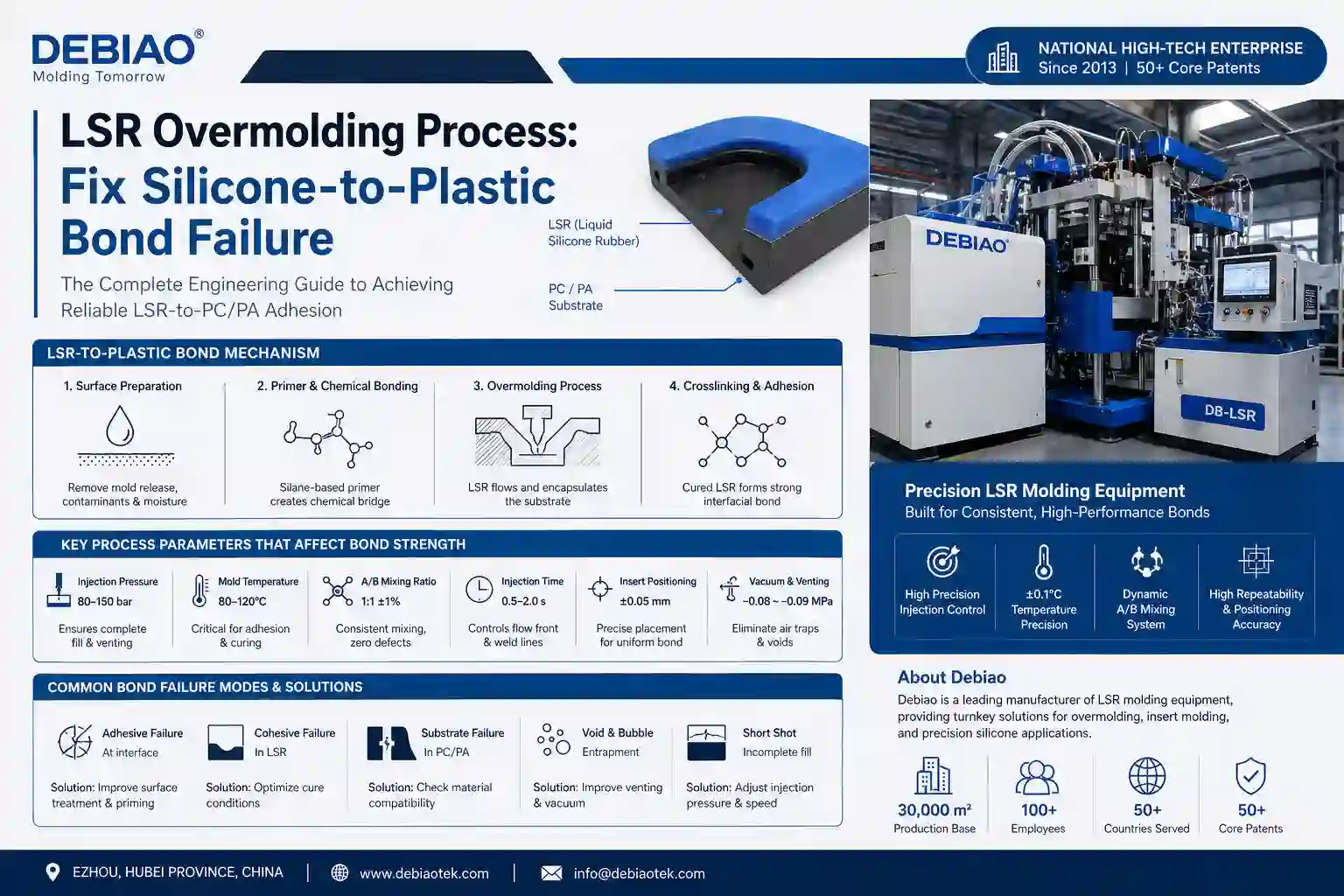
LSR Overmolding Process: Fix Silicone-to-Plastic Bond Failure
2026-04-26 23:58
Liquid silicone rubber bonds to almost nothing by default. Its surface energy sits around 20-22 mN/m — one of the lowest of any elastomer — which is precisely what makes silicone non-stick, biocompatible, and chemically inert in end-use. Those same properties make theLSR overmolding process onto polycarbonate (PC) or polyamide (PA) substrates genuinely difficult. When it works, you get a hermetic, flexible-to-rigid joint that survives IP68 testing, 85°C/85% RH aging, and drop tests. When it fails, you get delamination on the first pull test — usually at the 0.2 MPa peel strength threshold that most consumer electronics specs require.
The chemistry of that bond is only half the story. The other half is the machine. Specifically: injection pressure, temperature precision, A/B mixing consistency, and substrate positioning at the moment LSR hits the cavity. This guide — from our engineering team at Debiao, a national high-tech enterprise manufacturing LSR molding equipment since 2013 with 50+ core patents at our 30-acre facility in Ezhou, Hubei — breaks down the full liquid silicone overmoldingmechanism and explains what your machine parameters are doing to that bond interface.
Contents [ hide ]
Why LSR Doesn't Bond to Plastic Naturally
Liquid silicone rubber (LSR) is a two-component, platinum-catalyzed elastomer system. Component A carries the base polymer and the platinum catalyst. Component B carries the crosslinker (typically a methylhydrosiloxane) and inhibitors. Mixed 1:1, they vulcanize in the mold — usually at 120-180°C — forming a three-dimensional siloxane (Si-O-Si) network.
That network is chemically stable, hydrophobic, and low surface energy. Measured by contact angle, cured LSR surfaces sit around 105-115°, meaning water — and most adhesives — beads right off. For a wristband or a baby nipple, that's a feature. For aplastic and silicone bonding application, it's the enemy.
The substrates you're typically bonding to in consumer electronics have much higher surface energies — PC runs 40-43 mN/m, PA66 runs 40-45 mN/m, ABS around 36-39 mN/m. That energy gap between substrate and LSR is the thermodynamic barrier to adhesion. Wetting can't happen spontaneously when the adhesive's surface tension exceeds the substrate's. You have to engineer around it.
Three engineering routes exist. All three interact with machine parameters. That's the part most R&D engineers underestimate when they're designing an overmolded part.
The Three Mechanisms That Create a Real LSR-to-Plastic Bond
What Is Self-Bonding LSR and How Does It Work?
Self-bonding LSR grades contain built-in adhesion promoters — typically organofunctional silane coupling agents — incorporated directly into the formulation by the raw material supplier. During vulcanization, these silanes migrate to the LSR-substrate interface, where reactive functional groups (epoxy, amino, or vinyl) form covalent bonds with compatible surface chemistries on the plastic substrate.
Dow's SILASTIC™ LIM-6700 series, Wacker's Elastosil® LR 3xxx self-adhesive grades, and Shin-Etsu's KE-2000 series are the dominant options as of 2026. Each is optimized for specific substrate families. Dow LIM-6750, for example, bonds well to PA and glass-filled nylon. Wacker LR 3701/50 is engineered for PC and PC/ABS blends.
Self-bonding LSR is the cleanest route when it works. No primer application step, no plasma chamber capital cost, no added process variability. The tradeoff: self-bonding grades typically cost 20-35% more per kilogram than standard LSR. And they require precise cure conditions to activate the adhesion chemistry.
That last point matters enormously from a machine perspective.
When Do You Need a Primer — and What Does It Actually Do?
Primers are organofunctional silane solutions applied to the plastic substrate surface before overmolding — usually by spray, brush, or automated dispensing. The silane forms a molecular bridge: one end bonds chemically to the substrate (via hydrolysis with surface hydroxyl groups), the other end presents a functional group that crosslinks into the LSR network during vulcanization.
For PC substrates, primers based on epoxysilane or vinylsilane chemistry are most effective. For PA substrates, amino-functional silanes work better because they react with the amine and carboxylic end groups present in nylon's polymer chain.
Practical reality: primers add a process step that introduces variability. Coat thickness, flash-off time, and substrate cleanliness all affect final bond strength. In my experience, factories that struggle with primer-based bonding are usually dealing with inconsistent application rather than wrong primer chemistry. Automated primer dispensing with fixed flash-off timing is worth the investment at volumes above 20,000 units/month.
Plasma Treatment: Does It Help or Add Complexity?
Plasma treatment (atmospheric or vacuum) bombards the plastic surface with high-energy ions that oxidize surface hydrocarbons, generate polar functional groups (C=O, O-H, C-OH), and dramatically raise surface energy. A PC surface treated with air plasma for 30 seconds can jump from 40 mN/m to 65-72 mN/m — well above LSR's surface tension.
That sounds definitive. It isn't.
Plasma-activated surfaces have a shelf life. PC treated with air plasma typically loses 50-60% of its surface energy gain within 30-60 minutes as surface species reorient and atmospheric contamination accumulates. For a high-volume production line, plasma-treat-then- immediately-mold workflow is manageable. For facilities with variable takt time or long transfer distances between plasma station and press, it's a reliability nightmare.
⚙️ INSIDER NOTE
For most consumer electronics overmolding applications — earphone housings, smartwatch bands, USB-C port seals — we see the best cost-reliability tradeoff using a self-bonding LSR grade with plasma pre-treatment as a backup booster when bond specs are tight (>0.4 MPa peel). Using plasma alone without self-bonding LSR works, but leaves you exposed to any timing variation in your workflow. The chemistry routes stack; use them that way.
How Machine Parameters Drive Bond Strength
Here's what most material datasheets don't tell you: even with the right LSR grade and surface preparation, bond failure happens — and it happens specifically on machines with poor injection pressure control, drifting A/B ratios, or inconsistent mold temperatures. I've seen identical LSR grades produce 0.08 MPa peel strength on one machine and 0.43 MPa on another. Same substrate. Same primer. Different machine.
Why Does 56 MPa Injection Pressure Matter for Adhesion?
Bond formation at the LSR-plastic interface is a contact phenomenon before it's a chemical one. The platinum-catalyzed crosslinking reaction that locks the adhesion silanes into the substrate can only proceed where LSR is in intimate molecular contact with the surface.
LSR's low viscosity (20-80 Pa·s) means it flows easily — but viscosity alone doesn't guarantee interfacial contact pressure at micro-scale surface features. Plastic substrates from injection molding have micro-roughness: pockets, channels, and irregularities at the 5-50 micron scale that create interfacial voids if fill pressure is insufficient.
At 56 MPa injection pressure, LSR is forced into those micro-features — a mechanical interlocking component that supplements the chemical adhesion. Measured by SEM cross-section, the difference between a part filled at 20 MPa versus 50+ MPa shows visibly deeper LSR penetration into substrate micro-texture. Bond strength correlates directly.
The closed-loop control on our DB-LS series vertical machines holds injection pressure deviation below one thousandth throughout the fill. That consistency means every shot generates the same interfacial contact pressure — not just the first shot of the shift when the machine is running warm and stable.
How A/B Mixing Precision Affects Crosslink Density at the Interface
This is the connection that surprises most R&D engineers when I explain it.
LSR's platinum-catalyzed cure is a hydrosilylation reaction: Si-H groups on the crosslinker (Part B) react with vinyl groups on the base polymer (Part A) in the presence of platinum. The crosslink density — how tightly the three-dimensional siloxane network forms — depends directly on the stoichiometric ratio of Si-H to vinyl groups.
Standard LSR is formulated for a 1:1 A/B ratio. Shift that ratio to 1:1.05 (5% excess B) and you get slightly under-crosslinked surface layers: softer, more compliant, lower cohesive strength. Shift to 1:0.95 (5% deficit B) and you get unreacted vinyl groups on the surface — which actually reduces adhesion to primers because the silane coupling chemistry needs crosslinked LSR network to bond into.
Our DB-LS series detects and maintains A/B mixing ratio through real-time monitoring of both pump volumes and feed switch position, with dynamic closed-loop adjustment. Deviation stays below 0.1%. On a competitor machine I inspected in a Shenzhen facility last year — open-loop metering, no feedback — the ratio wandered between 1:0.93 and 1:1.08 over a 12-hour shift. Their peel strength results had a standard deviation of ±0.11 MPa. That's not a material problem. That's a machine problem.
What Happens to Bond Strength When Mold Temperature Drifts?
The adhesion silanes in self-bonding LSR formulations have activation temperatures. Below a threshold — typically 120°C for most commercial grades — the silane migration to the interface is incomplete and the crosslinking reaction that locks the bond is slow. Above about 190°C, thermal degradation of the bonding functional groups can begin.
The optimal cure window for most PC-compatible self-bonding LSR grades is 140-170°C with hold times of 25-45 seconds depending on wall thickness. Mold temperature variation of even ±8°C within that window measurably affects bond strength. According to Wacker Chemie's application data (2025), their Elastosil® LR 3701/50 shows a 15-22% reduction in peel strength on PC when mold temperature drops from 160°C to 148°C — a shift easily caused by inconsistent cooling channel flow or mold open time variation.
🟢 PRACTICAL TAKE
Before blaming your LSR grade or your primer for bond failures, pull your machine's process log and check three numbers across the last 500 cycles: injection pressure peak, A/B pump volume delta, and mold temperature at cycle start. If any of these shows a coefficient of variation above 2%, you have a machine-stability problem masquerading as a chemistry problem. Fix the machine first.
PC vs. PA vs. Other Substrates: Bonding Behavior Compared
Not all engineering plastics respond the same way to LSR overmolding. Here's a direct comparison of the substrates most common in consumer electronics, based on processing data from our customers and published adhesion studies as of 2025-2026:
| Substrate | Surface Energy | Best Bonding Route | Achievable Peel Strength | Key Risk |
|---|---|---|---|---|
| PC | 40-43 mN/m | Self-bonding LSR + plasma (optional) | 0.3-0.6 MPa | Carbonate group hydrolysis at high temp |
| PA66 (unfilled) | 40-45 mN/m | Amino-silane primer + self-bonding LSR | 0.4-0.7 MPa | Moisture absorption weakens interface over time |
| PA66-GF30 | 38-42 mN/m | Amino-silane primer required | 0.3-0.5 MPa | Glass fiber disrupts surface uniformity |
| PC/ABS blend | 37-42 mN/m | Self-bonding LSR (PC-grade) | 0.25-0.45 MPa | ABS domains reduce bonding site density |
| PBT | 36-40 mN/m | Epoxysilane primer + plasma | 0.2-0.4 MPa | Ester groups vulnerable to hydrolysis |
| LCP | 30-36 mN/m | Plasma essential; primer + self-bonding LSR | 0.1-0.25 MPa | Chemically inert; mechanical interlocking preferred |
PA66 generally gives the strongest LSR bonds of the engineering plastics commonly found in consumer electronics — partly because nylon's polar amine and carboxylic end groups are reactive with amino-functional silane primers, and partly because moisture-swollen nylon surfaces have elevated hydroxyl group density at the interface. The tradeoff is long-term durability: bond strength can degrade 25-35% after 500 hours of 85°C/85% RH aging if the interface isn't properly sealed against moisture ingress.
LCP is the problem substrate. Its extreme chemical resistance — exactly what makes it valuable for high-frequency antenna windows and connector housings — makes LSR adhesion genuinely difficult. I don't recommend relying on chemical bonding alone for LCP. Mechanical interlocking geometry (undercuts, through-holes, surface texture) should be designed into the part from the start.
Learn more about Debiao vertical LSR machine configurations for precision overmolding →
Why Vertical LSR Machines Outperform Horizontal for Overmolding
The overmolding process requires the plastic substrate to sit in the mold cavity with precise, repeatable positioning before LSR injection begins. Any movement — even 0.2 mm — shifts the LSR wall thickness distribution, alters where injection pressure peaks during fill, and changes the actual contact area where adhesion chemistry can occur.
On a horizontal machine, the substrate sits perpendicular to gravity, held by press-fit or fixture clips. LSR's injection flow — even at 56 MPa — can displace a lightly-held substrate during the initial fill front surge. You get asymmetric wall thickness, localized pressure concentration, and consequently inconsistent bond strength across the part.
On a vertical machine, the lower mold half is horizontal. The substrate sits on it the way a plate sits on a table. Gravity is the primary retention force before mold close, and clamping force drives it down during injection — not against it. The injection vector is vertical, aligned with gravity, which means the fill front advances uniformly around the substrate rather than pushing against it.
For overmolded USB-C housings, earphone nozzle seals, and smartwatch button membranes — all geometries where 0.3-0.5 mm LSR walls wrap around a rigid plastic frame — that vertical alignment makes the difference between a defect rate under 0.5% and one above 4%.
According to Grand View Research (2025), the global LSR market is expected to grow at 8.5% CAGR through 2030, with consumer electronics driving a disproportionate share of the precision overmolding segment. R&D teams designing for that market increasingly specify vertical machine architecture in their production equipment requirements — a shift I've watched happen across the past three years in customer specs arriving from Europe and North America.
Explore DB-LS1R and DB-LS2R vertical LSR machine specifications →
Bond Failure Diagnostic: 7 Root Causes and Machine-Side Fixes
When LSR peels off a plastic substrate, the instinct is to change materials. Nine times out of ten, the answer is in process parameters. Here's how to diagnose which one:
Delamination at edges only, center bond intact
Cause: Insufficient injection pressure at end-of-fill. Peripheral regions receive the lowest fill pressure. Fix: Increase peak injection pressure; verify closed-loop pressure hold is maintaining >30 MPa through full fill.Bond fails immediately on demolding (cohesive failure in LSR)
Cause: Under-cure from low mold temperature or short cure time. Fix: Verify mold temperature at ±3°C of target; add 5-8 seconds to cure dwell time.Bond fails immediately on demolding (adhesive failure at interface)
Cause: Primer not activated or self-bonding agent not reaching interface. Fix: Check A/B mixing ratio — if B-component is low, silane migration is impaired. Also verify primer flash-off time before mold close.Peel strength varies batch to batch, same material
Cause: A/B mixing ratio drift. Fix: Pull pump volume logs; if delta between A and B pumped volumes exceeds 1.5%, recalibrate metering system. Closed-loop machines like DB-LS series self-correct; open-loop machines accumulate drift.Bond passes initial QC, fails after 48-hour water soak at 60°C
Cause: Moisture-driven hydrolysis at silane-substrate interface. Most common with PA and PBT substrates. Fix: Use hydrophobic silane primer grades; consider mechanical interlock geometry to supplement chemical adhesion.LSR wells up around substrate edges (flash) and bond is weak nearby
Cause: Substrate positioning variation — substrate is moving during injection. Fix: Verify gravity-stabilized positioning (vertical machine advantage); add locating pins for substrates heavier than 30g.Bond strength adequate but surface appearance shows flow lines over substrate
Cause: Injection speed too high, causing jetting against substrate surface rather than laminar fill. Fix: Reduce injection speed during initial fill (0-20% fill volume); use dual-proportion hydraulic system to adjust flow profile through fill cycle.
Frequently Asked Questions
What is the LSR overmolding process?
LSR overmolding is a two-shot molding process where a pre-formed rigid substrate — typically engineering plastic, metal, or PCB assembly — is placed into a mold and liquid silicone rubber is injected around or over it. The LSR vulcanizes onto the substrate surface during the cure cycle, creating a permanent bond. It's used for waterproof seals, grip overmolds, and flex-to-rigid transitions in consumer electronics.
Why does liquid silicone overmolding fail on polycarbonate (PC)?
LSR has a surface energy of ~20-22 mN/m, well below PC's ~40-43 mN/m. Without surface treatment or adhesion promoters, LSR won't wet and bond to PC surfaces. Bond failure is also driven by machine-side factors: insufficient injection pressure (below 30 MPa), A/B ratio drift, or mold temperature below 140°C during cure can each independently cause delamination even with the correct LSR grade.
What LSR grades bond to PC without a primer?
Several commercial self-bonding LSR grades are formulated for direct adhesion to PC: Wacker Elastosil® LR 3701/50, Dow SILASTIC™ LIM-6750, and Shin-Etsu KE-2090 are the most widely used as of 2026. They incorporate built-in organofunctional silane adhesion promoters that activate during cure. Peel strength of 0.3-0.5 MPa on PC is achievable without additional primer when mold temperature and A/B mixing ratio are precisely controlled.
How does injection pressure affect LSR-to-plastic bond strength?
Higher injection pressure forces LSR into micro-scale surface features of the substrate, increasing the true contact area where adhesion chemistry can occur. At 56 MPa — the maximum on Debiao's DB-LS series — LSR penetrates substrate micro-roughness to depths measurable by SEM cross-section. Parts filled at 20-25 MPa show visibly lower interfacial contact density and correspondingly weaker peel strength compared to equivalent shots at 50+ MPa.
What is the optimal mold temperature for LSR overmolding onto PA66?
For most commercial self-bonding LSR grades on PA66, the target mold temperature is 150-170°C with a cure dwell of 30-50 seconds depending on wall thickness. Temperatures below 140°C lead to incomplete silane activation and weak bonds. Temperatures above 185°C risk thermal yellowing of PA66 and can begin degrading the silane functional groups. Mold temperature uniformity within ±5°C is critical — not just the setpoint.
How does A/B mixing ratio affect LSR bond quality?
The 1:1 A/B ratio is stoichiometrically optimized for both mechanical properties and adhesion activation. Deviations of ±3% or more produce under-crosslinked or over-crosslinked surface layers — both of which reduce cohesive strength near the bond interface and can prevent adhesion silanes from properly anchoring into the cured LSR network. Maintaining deviation below 0.1% (as on Debiao's closed-loop DB-LS series) is the machine-side standard for reliable overmolding.
Does plasma treatment improve LSR adhesion to PC permanently?
No — plasma treatment is temporary. PC surfaces lose 50-60% of their activation energy gain within 30-60 minutes of atmospheric exposure as surface species reorient. For reliable production, plasma treatment must be immediately followed by mold loading and injection. For high-volume lines, plasma integrated directly before the press is the only reliable configuration.
Where can I get a vertical LSR machine capable of precision overmolding from a Chinese manufacturer?
Debiao's DB-LS1R and DB-LS2R vertical LSR machines are purpose-built for insert and overmolding applications, with 56 MPa closed-loop injection and sub-0.1% A/B mixing precision. We supply factory-direct from Ezhou, Hubei — no distributors. Contact us at chdeb.com/contact or WhatsApp +86-18321638559 for specifications and pricing.
The Bonding Problem Is Solvable — Mostly at the Machine Level
Key things to take from this:
LSR's low surface energy (~20-22 mN/m) makes adhesion to PC and PA a designed outcome, not a default one. You need either self-bonding LSR grades, primer chemistry, plasma treatment, or a combination.
Machine parameters are not passive in this equation. Injection pressure at 56 MPa, A/B mixing held within 0.1%, and mold temperature stable within ±5°C of target directly determine whether your adhesion chemistry actually activates.
Vertical machine orientation stabilizes substrate position during injection — eliminating the fill-front displacement that causes wall thickness asymmetry and localized bond failure on horizontal machines.
LCP is genuinely difficult. Design mechanical interlocking geometry into the part rather than relying on chemical adhesion alone.
When bond failures appear, run a machine parameter audit before changing materials. Most failures trace to pressure deviation, ratio drift, or temperature instability.
Honestly, the most common mistake I see from R&D teams designing LSR overmolded consumer electronics is treating machine selection as a procurement afterthought — picking the cheapest press that fits the part size, then fighting chemistry problems for months. The bond interface is formed under machine-controlled conditions. Specify the machine parameters first.
References & Sources
Elastosil® LR Self-Adhesive Liquid Silicone Rubber — Technical Data — Wacker Chemie AG (2025)
SILASTIC™ LIM Series LSR for Injection Molding — Processing Guide — Dow Inc. (2025)
Liquid Silicone Rubber Market Size, Share & Trends Report — Grand View Research (2025)
ISO 294-1: Plastics — Injection Moulding of Test Specimens — International Organization for Standardization
Struggling with LSR-to-Plastic Bond Failures in Production?
Factory-direct DB-LS series vertical LSR machines. 56 MPa closed-loop injection. Sub-0.1% A/B mixing precision. Free process consultation from our engineering team.
Technical Director at Ezhou Debiao Machinery Co., Ltd. — A national high-tech enterprise manufacturing LSR injection molding equipment since 2013, with 50+ core patents and a 30-acre production base in Ezhou, Hubei, China. Specializes in precision LSR overmolding process engineering for medical, electronics, and consumer product applications globally.
ezdbjx@163.com · WhatsApp: +86-18321638559