
Double-Slide LSR Injection Machine: Cut Downtime, Boost Output
2026-03-29 22:23
On most silicone contract manufacturing floors, the machine isn’t the bottleneck. The loading is.
If you’re doing insert molding or any job that needs manual placement, your press can be “ready to shoot”… and still sit there waiting because the operator is fishing tiny metal inserts from a tray, aligning them, checking orientation, and closing the safety gate. I’ve watched factories run a technically capable LSR cell at 55–65% OEE just because loading eats 8–15 seconds every cycle.
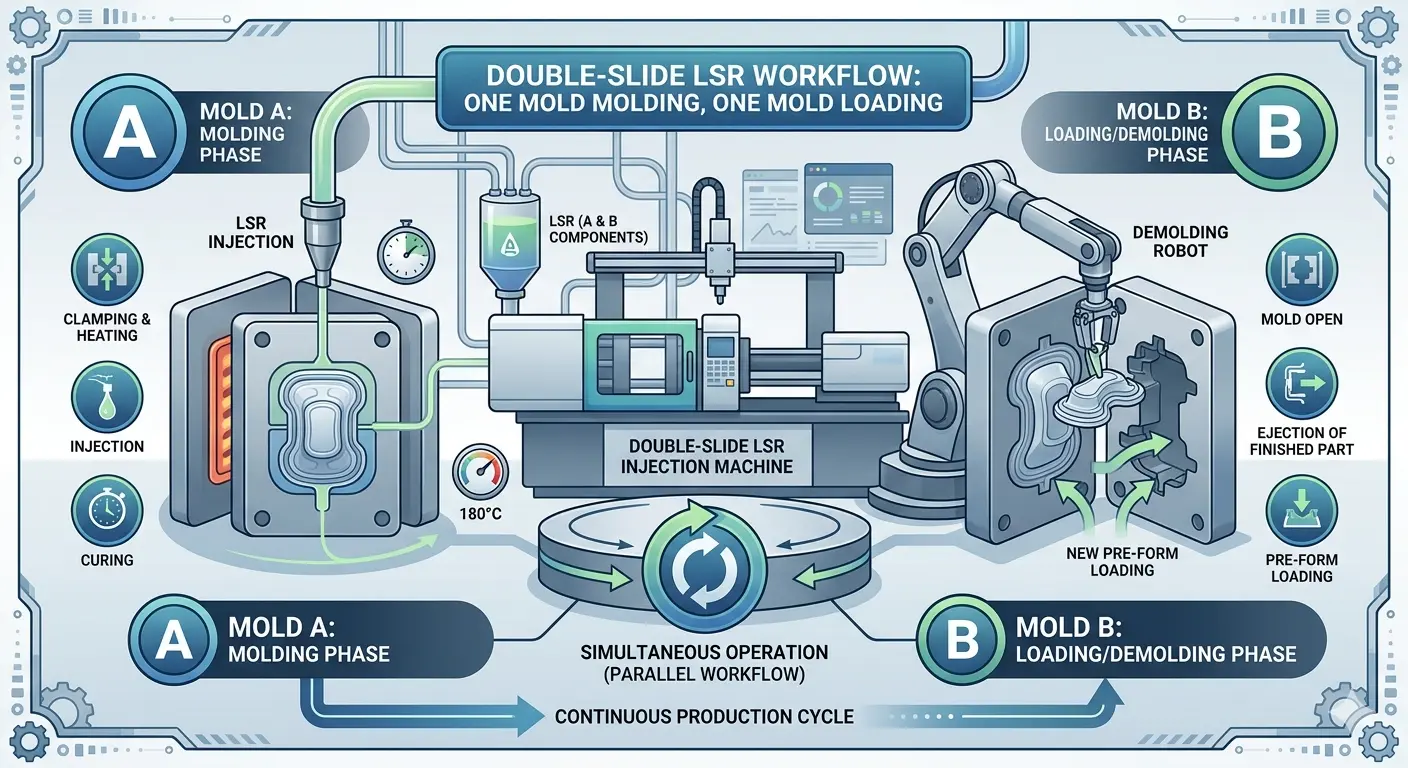
A double-slide LSR injection machine fixes that by separating “molding time” from “loading time.” While one mold is inside the clamping area injecting and curing, the other mold is outside for unloading and insert placement. No waiting. No empty clamping area. Just continuous rhythm.
This article is written from the Debiao engineering side. We’ve been manufacturing liquid silicone rubber equipment since 2013, and our factory is built around stable A/B metering and repeatable production—not demo-room specs. We’ll compare single-slide vs twin slide vertical LSR systems and explain where a model like the DB-LS2R series pays back fast, and where it doesn’t.
Contents [ hide ]
What a Double-Slide LSR Injection Machine Actually Does
A double-slide LSR injection machine is a vertical clamping system with two working stations on a sliding table: left and right. One station is inside the clamping area for mold closing, injection, and curing. The other station is outside, where the operator unloads finished parts and loads inserts for the next cycle.
When the cycle ends, the table swaps stations. The “outside” mold goes in. The “inside” mold comes out. Then you repeat.
This two-station workflow is a standard concept in vertical injection molding equipment: two operating stations alternate so loading/unloading happens while molding continues.
💡 PRO TIP
If your operators ever say “the machine is waiting for me,” you’re already in double-slide territory. A twin-station table isn’t about fancy automation—it’s about not letting a $60k–$150k asset idle because someone is lining up a 10-cent insert.
Why Single-Slide Cells “Feel Busy” but Produce Less
Single-slide vertical machines are solid for many jobs. The issue is that they’re sequential: open → unload → load inserts → close → inject → cure → open… and everything happens in one station.
Two things quietly kill output:
Loading time is non-value-added time. Your barrel heaters and pumps are ready, but nothing happens until loading finishes.
Human variation becomes cycle time variation. A “fast” operator might load inserts in 6 seconds. A tired operator at 2 a.m. might need 14 seconds. Your mold doesn’t care—your daily output does.
Contract manufacturing makes this worse. You’re not running one stable part for 6 months. You’re switching jobs, inserts, fixtures, inspection rules. The line is always adapting.
That’s why the double-slide idea keeps showing up in vertical machines: while one mold is molding, the other station can be loaded at the same time, improving output efficiency and safety.
Single-Slide vs Double-Slide: A Factory-Style Comparison
| Decision Factor | Single-Slide Vertical LSR | Double-Slide (Twin Slide Vertical LSR) |
|---|---|---|
| Where loading happens | Inside the only station (machine stops) | Outside while molding continues |
| Best match | Simple parts, minimal inserts, longer cure times | Insert molding, short cycles, frequent job changes |
| Operator impact on output | High | Lower (loading overlaps curing) |
| Safety + ergonomics | OK (depends on guarding & layout) | Better separation between molding zone and loading zone |
| Typical output gain | Baseline | Often +20% to +80%; can approach 2× if loading dominates |
Notice what I didn’t say: “double-slide always doubles output.” That’s marketing. The real answer depends on your time balance. But yes—on the right job, it can feel like a throughput cheat code.
The Throughput Math: When Output Can Really Double
Here’s the clean way to think about it.
On a single-slide machine:
Cycle time = molding time + loading time
On a double-slide machine:
Cycle time ≈ max(molding time, loading time) + table change time
Quick scenario (very common in insert overmolding):
Injection + cure + open/close = 18 seconds
Unload + place inserts + check orientation = 16 seconds
Table change = 2 seconds
Single-slide cycle: 18 + 16 = 34 seconds → about 106 parts/hour per cavity.
Double-slide cycle: max(18,16) + 2 = 20 seconds → 180 parts/hour per cavity.
That’s a 70% jump—without changing your mold. And if loading is slower than molding (say 25 seconds loading vs 15 seconds molding), the gain gets closer to 2×. That’s the “doubling” people feel on the floor.
🟢 PRACTICAL TAKE
Before you quote any new machine, time your process for 30 cycles and write down: (1) molding time, (2) loading/unloading time, (3) micro-stoppages. If loading takes >40% of your total cycle on a single-station setup, a twin-slide vertical LSR layout is usually the fastest payback you’ll ever see in molding equipment.
DB-LS2R Series: What to Check Before You Spec It
The DB-LS2R series is our vertical double-slide configuration for LSR work where insert loading and part handling would otherwise starve the machine.
Here’s what a plant manager should verify during the consideration stage:
Slide table stability and repeatability: If the table alignment drifts, your insert position drifts. Then your scrap rate eats your “extra output.”
Clamping and injection control: For LSR, consistency is king. Our systems are designed around closed-loop control and stable A/B mixing (1:1) because small ratio drift becomes hardness drift and sealing performance drift.
Injection pressure headroom: For many LSR jobs—especially thin-wall seals around inserts—higher injection pressure capacity gives you process margin. Debiao’s liquid silicone injection systems are designed to reach up to 56 MPa, with real-time monitoring and dynamic adjustment to maintain stable mixing. (Company spec from our published technical highlights.)
Integration plan: Manual loading today, semi-auto tomorrow, robot next year. Make sure the layout gives you a clean upgrade path.
Browse Debiao vertical LSR injection molding machines (DB-LS series) →
How to Set Up a Twin-Slide Vertical LSR Cell (Without Chaos)
Double-slide output gains disappear fast if the station outside the clamping area becomes a mess—mixed inserts, wrong orientation, missed visual checks. The fix is boring, but it works:
Dedicated insert trays per station: Left station tray, right station tray. No “shared” bins.
One-direction orientation rules: Color mark, notch, or keyed pocket. Don’t trust memory.
Simple go/no-go gauges: If the insert isn’t seated, the gauge shouldn’t fit. Do that check outside while molding continues.
Table swap standard work: Who presses swap, when, and what is the “ready” signal? Put it on the wall.
Quality gate timing: Inspect on the outside station so the inside station never waits.
Worth mentioning: a twin-station workflow also makes it easier to introduce pick-and-place later, because your robot has clean top access to the external station. That’s a smoother step than trying to retrofit robots into a single-station workflow where the press must pause for access.
Frequently Asked Questions
What is a double-slide LSR injection machine?
A double-slide LSR injection machine is a vertical molding system with two working stations on a sliding table. One mold runs inside the clamping area while the second station stays outside for unloading and insert loading. After each cycle, the table swaps positions so molding continues without waiting for manual handling.
Can a twin slide vertical LSR machine really double output?
Yes—when loading/unloading time is similar to or longer than molding time. In that case, double-slide cycles run close to the longer of the two times rather than the sum, so throughput can approach 2×. If your cure time dominates and loading is quick, gains are smaller (often 20–40%).
What jobs benefit most from a DB-LS2R series machine?
High-mix silicone contract manufacturing and insert molding benefit most—especially when operators need time to place metal inserts, check orientation, or do quick go/no-go checks. If you’re running short cycle parts where handling time starves the press, DB-LS2R-style twin-station workflow usually gives the fastest payback.
Is double-slide only useful for inserts?
Not only for inserts. It also helps when you have manual demolding, manual trimming, or in-process checks that slow down cycle restart. Inserts just make the benefit obvious because the handling steps are predictable and repeat every cycle.
What’s the MOQ for Debiao vertical LSR injection molding machines?
Standard MOQ is 1 unit for most machinery. For first-time purchases under 3 units, we offer a 5% discount so you can run a trial and validate the cycle time improvements on your real parts.
How do I estimate payback for a double-slide LSR machine?
Start with your time study: single-station cycle = molding + loading. Double-slide cycle ≈ max(molding, loading) + swap. Convert each to parts/hour, then multiply by your contribution margin per part. For contract manufacturing, also include savings from fewer micro-stoppages and less overtime to hit delivery schedules.
What to Do Next (If You’re in the Consideration Stage)
Time-study your line for 30 cycles and split molding time vs loading time.
List every manual step that forces the press to wait (insert placement, orientation check, demolding, trimming).
Decide what you want to overlap with curing—because that’s what twin-station design buys you.
Then spec the machine. Not the other way around.
If you want, we can review your cycle video and give a basic “single vs double-slide” output model. It’s usually obvious within 10 minutes whether a double-slide layout will be a mild upgrade or a major step change.
References & Sources
Double Slider Type Vertical Injection Moulding Machine (Working Principle) — Swift Machines (accessed 2026)
TW-V-2S Double Slide Table Vertical Injection Machine — TW Machines (accessed 2026)
Double Slide Series Vertical Injection Molding Machine (Two Lower Molds Concept) — MIN-HUI Plastic Machinery (accessed 2026)
Need a Double-Slide LSR Injection Machine for Contract Manufacturing?
Factory-direct. Vertical twin-station workflow. MOQ 1 unit. 5% discount on first order under 3 units.
Technical Director at Ezhou Debiao Machinery Co., Ltd. — Manufacturer of liquid silicone rubber injection molding equipment since 2013. We focus on stable A/B metering, repeatable molding cycles, and practical production line integration for global silicone contract manufacturers.
ezdbjx@163.com · WhatsApp: +86-18321638559