Import Vertical LSR Machine — Custom & Factory Direct
2026-07-28 23:18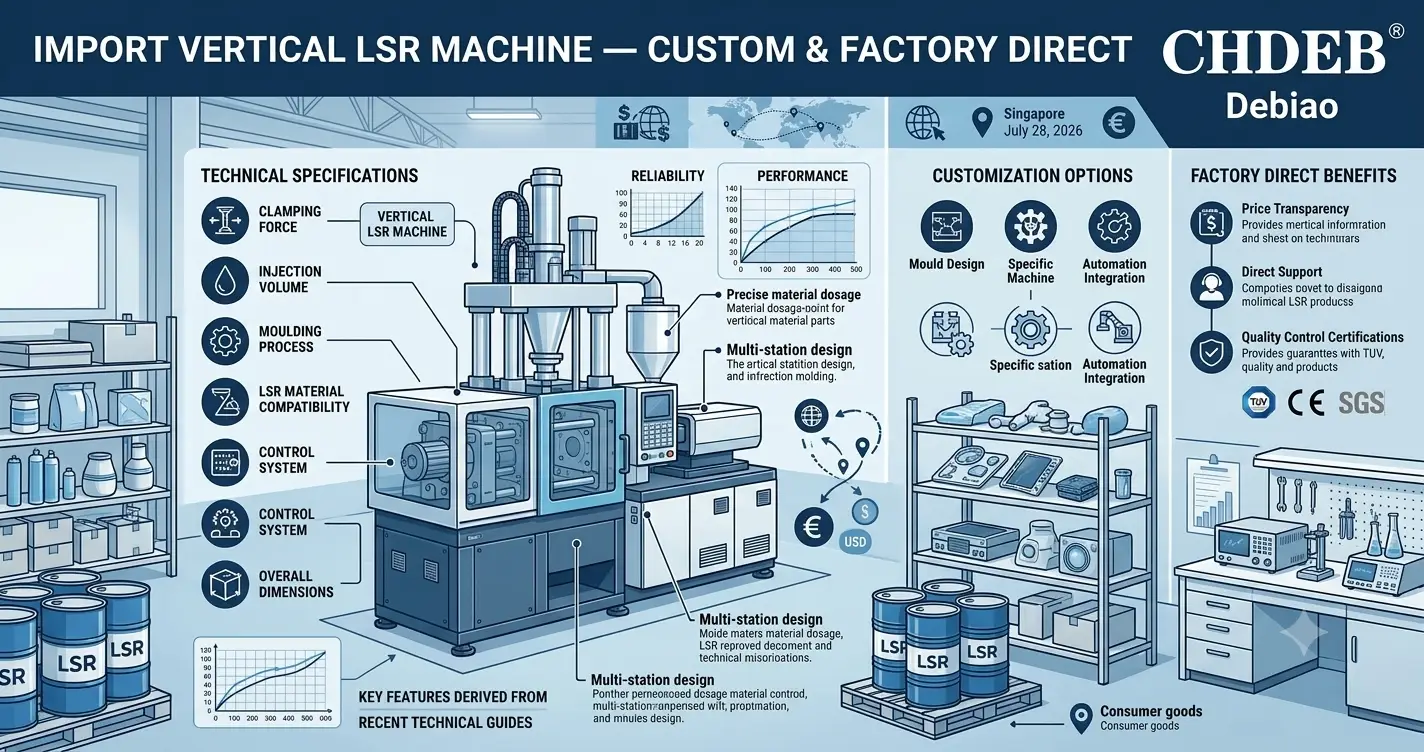
Importing a vertical LSR machine for the first time is not just a purchasing decision — it's a technical commitment that can define your production line's output quality for the next decade. Most overseas buyers I speak with aren't afraid of the price. They're afraid of the gap: different time zones, different engineering vocabularies, and a supplier who sends a machine that doesn't match what was agreed on paper.
This guide explains exactly how Debiao — a national high-tech enterprise with 50+ core patents, operating from a 30-acre manufacturing base in Ezhou, Hubei, China since 2013 — structures its full-process custom service to eliminate that gap. From your first RFQ to live remote commissioning, we handle it in English, in detail, at every step.
Contents [ hide ]
What Is a Vertical LSR Injection Molding Machine?
LSR Defined — and Why It's Not the Same as Solid Silicone
Liquid Silicone Rubber (LSR) is a two-component, platinum-catalyzed silicone system that vulcanizes at temperatures typically between 120°C and 200°C. It offers significantly better fluidity than solid HTV (High-Temperature Vulcanized) silicone, enabling it to fill complex, thin-walled mold geometries with minimal flash — a property that makes it the material of choice for medical-grade seals, infant bottle nipples, wearable device components, and food-contact gaskets.
Unlike HTV silicone, which is processed in sheet or strip form and pressed into molds, LSR is pumped as a liquid from two separate barrels (the A and B components), metered at a precise 1:1 ratio, mixed in a static mixer, and injected under controlled pressure directly into a closed mold cavity. That's a fundamentally different process — and it demands purpose-built equipment. A standard thermoplastics injection machine cannot run LSR correctly. Full stop.
Why "Vertical" Matters for Your Mold Design
A vertical LSR injection molding machine clamps and injects on a vertical axis. This configuration gives you two structural advantages that horizontal machines don't offer by default. First, insert molding becomes dramatically easier — gravity holds metal inserts, fabric components, or plastic substrates in place inside the lower mold half while the upper half descends to close. Second, with a dual-slide (two-platen) design like our DB-LS2R, one operator can load inserts on the exposed slide while the machine is simultaneously molding on the other — real parallel operation, not just theoretical.
For industries like electronics (connectors with metal pins), medical (over-molded catheter components), and infant products (nipples with integrated valves), vertical orientation is not a preference. It's an engineering requirement.
The Real Risk When You Import a Custom Vertical LSR Machine
I've had buyers tell me, flat out: "Mr. Xiao, I trust your machine specs. What I don't trust is the communication process." That's honest — and fair. Cross-border equipment procurement has a well-earned reputation for going wrong in ways that aren't about machine quality at all.
Three Points Where Cross-Border Orders Break Down
After more than a decade of exporting to Southeast Asia, the Middle East, and beyond, I've seen the same failure patterns repeat. They're predictable — which means they're preventable:
Spec lock-in without real consultation. The buyer sends a basic RFQ, the supplier sends a quote, and both sides assume they're aligned. Six weeks later, the machine arrives without the vacuum mold clamping option that was "implied" in the conversation. This is the most common problem, and it costs everyone.
No bilingual engineering documentation. A machine's control panel logic, hydraulic circuit diagram, and maintenance manual arriving in Chinese-only format is not just inconvenient — it creates a safety and compliance liability for the buyer's operators.
Commissioning abandoned after delivery. Some suppliers treat "shipped" as "done." If your in-house team has never run an LSR machine before, a machine sitting on your floor with no one who can calibrate the A/B feed pressure or set the cure cycle parameters is a very expensive problem.
⚙️ INSIDER NOTE
In our workshop, we've seen firsthand that the single biggest driver of post-delivery disputes is not machine malfunction — it's misaligned expectations during the pre-order specification phase. That's why our process starts with a structured needs-assessment call, not a price quote. We lock specs first. Price follows.
DB-LS1R vs. DB-LS2R: Choosing the Right Model
Debiao's vertical LSR lineup currently covers two core configurations. The choice between them is not about budget — it's about your production workflow and whether you need continuous parallel operation or a simpler single-station setup.
Side-by-Side Specification Comparison
| Specification | DB-LS1R Series (Single-Slide) | DB-LS2R Series (Double-Slide) |
|---|---|---|
| Clamping Configuration | Single sliding platen | Dual sliding platens (alternating) |
| Production Mode | Sequential (load → mold → unload) | Parallel (load one while molding the other) |
| Best For | Small-to-medium batches, R&D, product trials | High-volume continuous production lines |
| Insert Molding | ✅ Supported | ✅ Supported — with reduced operator idle time |
| Operator Requirement | 1 operator per station | 1 operator for both slides simultaneously |
| Custom Configuration | ✅ Available | ✅ Available |
| Typical Industries | Medical, infant care, electronics prototyping | Medical, automotive seals, consumer electronics (mass production) |
| MOQ | 1 unit | 1 unit |
Short answer: if you're running trial production or your cycle time allows for sequential loading, the DB-LS1R is the leaner choice. If you're targeting output above a certain volume threshold and labor cost reduction matters, the DB-LS2R's dual-slide design pays for itself quickly. Not sure which applies to you? That's exactly what our pre-order needs assessment is designed to resolve — no charge, no obligation.
Compare the full DB-LS1R and DB-LS2R technical specifications →
Full-Process Service: From RFQ to Remote Commissioning
This is where Debiao is genuinely different from most Chinese equipment manufacturers — and I'm not saying that as a sales line. Our service model was rebuilt specifically because first-time importers kept running into the same communication failures I described above. The process has five distinct stages, each with English-language deliverables.
Needs Assessment (Week 1). A bilingual technical call — or WhatsApp exchange if you prefer async — to document your product specifications, production volume targets, mold cavity count, insert requirements, and downstream quality standards (FDA, LFGB, ISO 10993 for medical). We produce a written Needs Summary in English for your sign-off before any design work begins.
Custom Equipment Proposal (Week 2–3). Based on your confirmed specs, we configure your vertical LSR machine — selecting clamping force, injection unit size, hydraulic circuit parameters, and optional vacuum chamber — and deliver a formal Technical Proposal with labeled schematics. You review, markup, return. We revise until it's locked.
Precision Manufacturing (Week 4–8 for standard builds; 8–12 for heavy custom). Production at our Ezhou factory — 30 acres, 2 standardized workshops, 40-million-yuan infrastructure. Key milestones shared via photo/video update at 50% and pre-FAT stages.
Factory Acceptance Test (FAT) — Live Video. Before the machine ships, we run a live FAT session over video call with your team. We inject real LSR material, measure A/B mixing ratio consistency, demonstrate closed-loop pressure control at up to 56MPa, and record all parameters in a bilingual FAT report you keep on file.
Remote Commissioning Support. After your machine arrives and your team installs it, we provide up to 3 scheduled remote commissioning sessions via video call. We walk your operators through parameter setup, cure cycle calibration, and first-article inspection protocol. All machine documentation — control manual, hydraulic diagram, maintenance schedule — is delivered in English.
🟢 PRACTICAL TAKE
One thing I always recommend to first-time LSR equipment importers: schedule your FAT video call at least two weeks before the agreed shipping date. That gives you time to request adjustments — mold mounting plate dimensions, control panel language, electrical standard (CE/UL) — without delaying your production timeline. Rushing the FAT to hit a ship date is how small mismatches become expensive retrofits.
Vertical vs. Horizontal LSR Machines — Which Fits Your Application?
Honestly, this question comes up in almost every pre-sales conversation. The answer depends less on machine preference and more on your mold architecture and production process design.
| Factor | Vertical LSR Machine (DB-LS1R / DB-LS2R) | Horizontal LSR Machine (DB-WS-LSR) |
|---|---|---|
| Insert Molding | ✅ Ideal — gravity holds inserts in place | ⚠️ Possible but requires fixtures |
| Floor Space | Smaller footprint | Larger footprint |
| Automation Integration | Manual to semi-auto | Fully automatic (robot takeout standard) |
| Output Volume | Small-to-medium batches | High-volume continuous runs |
| Typical Products | Medical seals, nipples, electronics over-molding | Automotive gaskets, large-scale consumer parts |
If your products require metal or plastic inserts to be positioned before closing the mold — think connector seals with copper pins, or over-molded medical device grips — vertical is almost always the better starting point. The DB-WS-LSR fully automatic horizontal machine becomes the right call when you're running the same part in high volume with no insert loading and want robotic part removal integrated from day one.
Learn more about Debiao's DB-WS-LSR Fully Automatic Horizontal LSR Injection Molding Machine →
Certifications and Standards You Should Verify Before You Import
When you're importing capital equipment across borders, certifications are not box-ticking exercises. They're your liability protection — with your customers, your regulators, and your insurance carrier.
Here's what to verify when evaluating any Chinese LSR machine manufacturer, including Debiao:
National High-Tech Enterprise Certificate: Issued by China's Ministry of Science and Technology. Debiao holds this certification — it requires documented R&D investment, validated intellectual property (we hold 50+ core patents), and annual government audit. It's not a marketing badge; it's an audited credential.
CE Certification: Required for machines entering the EU and many markets that follow EU machinery standards (Machinery Directive 2006/42/EC). If your market requires CE, confirm it covers the full machine assembly — not just selected components.
ISO 10993 compliance (for medical applications): Your product biocompatibility testing is separate from machine certification — but the machine's material-contact surfaces, cleaning protocols, and contamination controls directly affect your ability to pass ISO 10993 testing for finished medical silicone parts.
FDA 21 CFR 177.2600: If you're producing food-contact or infant-care silicone products for the U.S. market, your LSR material must comply — but your production equipment's cleanliness and contamination control protocols are part of your facility audit scope.
GB/T 12999: China's national standard for injection molding machine general technical conditions. All Debiao machines are designed and tested against this standard as a baseline.
💡 PRO TIP
Ask your supplier for the actual certificate document — not just a logo on the website. A legitimate National High-Tech Enterprise certificate includes a registration number you can cross-verify in China's official enterprise database. We're happy to share ours at any stage of your evaluation process.
Ready to Import Your Custom Vertical LSR Machine?
Here's what to take away from this guide:
Vertical LSR injection molding machines are the correct choice for insert molding, small-footprint operations, and products requiring precise positioning before mold close.
The DB-LS1R (single-slide) suits trial production and medium batches; the DB-LS2R (double-slide) enables parallel loading for higher-volume lines.
The most common failure mode in cross-border custom equipment orders is communication breakdown — not machine quality. Debiao's 5-stage full-process model is specifically designed to close that gap.
Standard models ship in 15–25 days; custom configurations in 30–45 days. MOQ is 1 unit, and first-time orders of up to 3 units qualify for a 5% discount.
All documentation — technical proposals, FAT reports, operation manuals — delivered in English.
That said — no guide substitutes for a real conversation about your specific product, mold design, and production environment. If you're at the decision stage, the most useful next step is a 30-minute technical call with our team. No sales pitch. Just specs.
Frequently Asked Questions
What is the minimum order quantity (MOQ) when I import a vertical LSR machine from Debiao?
The standard MOQ is 1 unit for both the DB-LS1R and DB-LS2R series. First-time buyers purchasing up to 3 units receive a 5% discount to support initial product evaluation. There is no penalty for starting with a single machine.
How does Debiao handle the language barrier during custom equipment specification?
All technical documentation — needs assessment, equipment proposals, schematics, FAT reports, and operation manuals — is delivered in English. Pre-sales and commissioning communication is conducted via email, WhatsApp, or scheduled video call in English. Mr. Xiao's team handles international accounts directly.
What is the typical lead time for a custom vertical LSR injection molding machine?
Standard configurations of the DB-LS1R and DB-LS2R ship within 15–25 business days from order confirmation. Custom builds — involving modified clamping force, non-standard platen dimensions, vacuum chamber integration, or special electrical standards — typically require 30–45 business days. Lead time is confirmed in writing before order placement.
Which is better for medical silicone parts — the DB-LS1R or the DB-LS2R?
Both models support medical-grade LSR processing. The DB-LS1R is better suited for complex-geometry medical parts produced in moderate volumes where precise manual insert placement is critical. The DB-LS2R is more appropriate when volume demand justifies parallel loading to reduce cycle time. The right choice depends on your cavity count, annual production target, and cleanroom integration requirements — all factors we review in the needs assessment.
Does Debiao provide remote commissioning support after the machine is delivered?
Yes. Debiao provides up to 3 scheduled remote commissioning sessions via video call after delivery. Sessions cover parameter setup, A/B feed pressure calibration, cure cycle configuration, and first-article inspection guidance. Lifelong operation and maintenance support is also available beyond initial commissioning.
What certifications does Debiao hold that are relevant for export markets?
Debiao is a certified National High-Tech Enterprise (国家高新技术企业) with 50+ core patents. Our machines are designed against GB/T 12999 (China injection molding machine standard) and CE certification is available for machines destined for EU-standard markets. Specific certification requirements for your target market can be addressed during the specification phase.
Can I run food-grade or infant-care silicone products on a Debiao vertical LSR machine?
Yes. The DB-LS1R and DB-LS2R are fully compatible with food-grade and infant-care LSR materials from major suppliers including Dow, Wacker, Shin-Etsu, and Momentive. The machines' closed injection system minimizes contamination risk. Compliance with FDA 21 CFR 177.2600 or LFGB for finished products is determined by your material selection and facility conditions — not machine limitations alone.
What payment terms does Debiao offer for first-time international buyers?
Standard payment terms for international orders are T/T (bank transfer) with a deposit at order confirmation and the balance prior to shipment. Specific terms — including deposit percentage and milestone payment structures for larger custom orders — are negotiated case-by-case. Contact Mr. Xiao directly at ezdbjx@163.com or WhatsApp +86-18321638559 to discuss your order structure.
References & Sources
Liquid Silicone Rubber Market Size, Share & Trends Analysis Report — Grand View Research (2025)
ISO 294: Plastics — Injection Moulding of Test Specimens — International Organization for Standardization
FDA 21 CFR 177.2600 — Rubber Articles Intended for Repeated Use — U.S. Food and Drug Administration
ISO 10993-1: Biological Evaluation of Medical Devices — International Organization for Standardization (2018, confirmed 2025)
Liquid Silicone Rubber Market — Global Forecast to 2030 — MarketsandMarkets (2025)
ELASTOSIL® Liquid Silicone Rubber — Processing & Applications — Wacker Chemie AG
Importing a Vertical LSR Machine for Your Production Line?
Factory-direct pricing. 50+ core patents. Full English-language support from spec to remote commissioning.
Technical Director at Ezhou Debiao Machinery Co., Ltd. — A national high-tech enterprise specializing in LSR injection molding equipment since 2013, with 50+ core patents and a 30-acre manufacturing base in Ezhou, Hubei, China. Serving silicone product manufacturers across mainland China, Southeast Asia, the Middle East, and beyond.
ezdbjx@163.com · WhatsApp: +86-18321638559